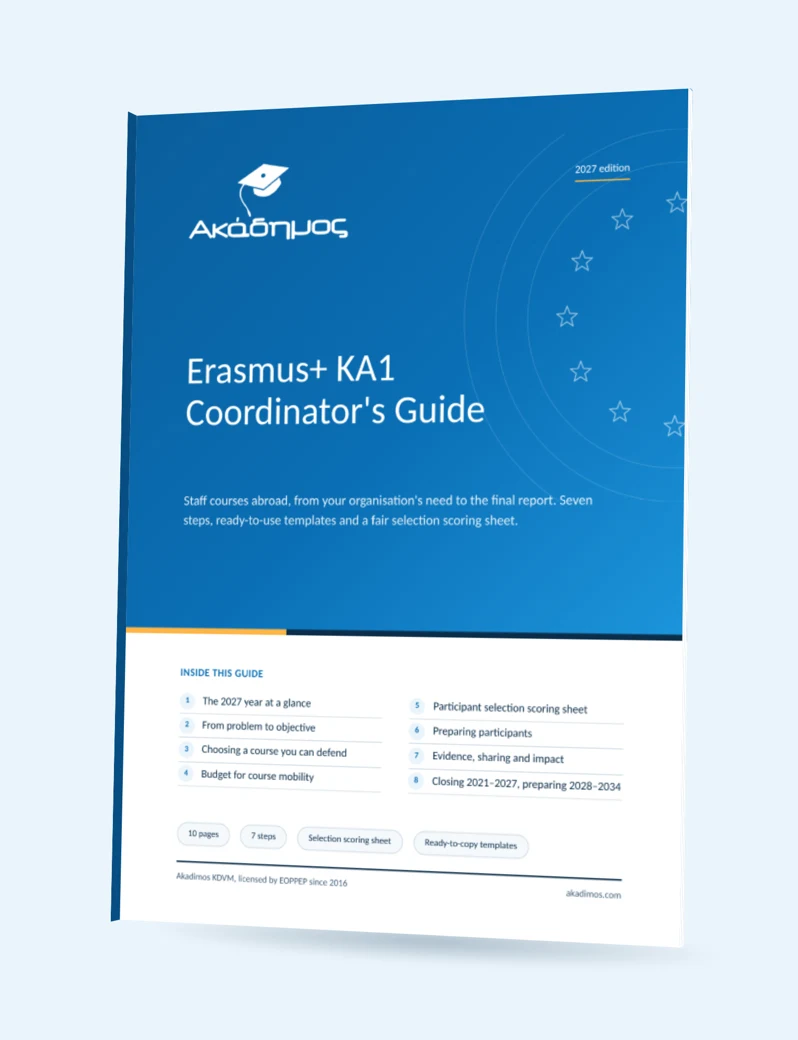
How to select staff for an Erasmus+ KA1 mobility
Selecting staff for an Erasmus+ KA1 mobility should be fair, transparent and documented, and it should follow the goals of your Erasmus Plan or project. Publish the criteria before anyone applies, score every application against the same sheet, keep a short record of the decision and a waiting list. Five criteria cover most cases: link to your goals, the role the person will play afterwards, commitment to share, inclusion, and readiness to travel.
Why selection matters
Your National Agency does not only look at what your staff learned. It also looks at how you chose them. The Erasmus quality standards ask organisations to select participants through a fair and transparent process, and a clear selection record is one of the easiest ways to show good management at a monitoring visit or in your final report.
A good process also protects you inside your organisation. When colleagues know the criteria in advance, a "no" this year is easier to accept, and the waiting list gives them a clear next step.
Five criteria that work in most organisations
| Criterion | The question it answers | Points |
|---|---|---|
| Link to your goals | Does the training serve a goal of the Erasmus Plan or the project? | 0 to 3 |
| Role afterwards | Will the person lead or teach the change back home? | 0 to 3 |
| Commitment to share | Has the person described how they will share what they learn? | 0 to 3 |
| Inclusion | Is this a first mobility, or does the person face barriers to taking part? | 0 to 2 |
| Readiness | Is the person available on the course dates, with the language level the course needs? | 0 to 2 |
The maximum is 13 points. Keep the scale small: a 0 to 3 scale is quick to use and easy to explain.
The process, step by step
- Publish a short call. One page: the goal of the mobility, the course or courses, the dates, the criteria and the deadline.
- Collect a short application. Five questions are enough: role, motivation, link to the goals, how they will share, availability.
- Score with two people. Two colleagues score separately, then agree. The head or director confirms.
- Record the decision. Keep the scores and one sentence per decision. This is your evidence for the National Agency.
- Keep a waiting list. If someone cannot travel, the next person on the list goes. With most course providers, a name change is simple.
- Tell everyone the result. Including the colleagues who were not selected, with the reason and their place on the list.
Common mistakes to avoid
- Choosing the same people every year. Spread the opportunity, unless your goals clearly need the same role.
- Choosing the course first and the people later. Start from the goal, then the people, then the course.
- Sending three colleagues to the same course when your goals need different skills. A team can travel together and still join different courses in the same week.
Questions coordinators ask us
Can the head or director be selected?
Yes, if the training serves the goals and the role. Use the same criteria and record the decision like any other.
Do we need a selection committee?
Not a formal one. Two people who score separately and a short record are usually enough for a small organisation.
What if only one person applies?
Score the application anyway and record it. It shows the process was open and the criteria were met.
Sources
Facts checked on 5 November 2026. Found something out of date? Tell us and we will fix it.